
Arizona Commercial Lease CAM Charges Explained
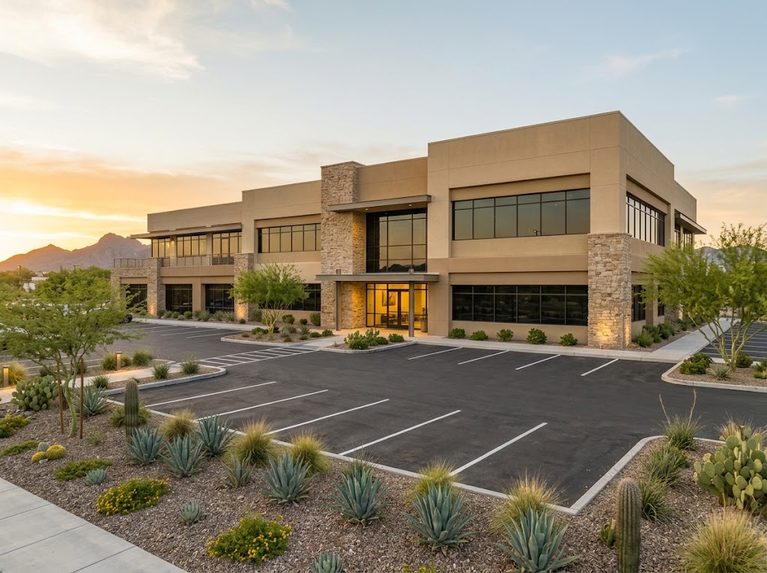
If you’ve been shopping for commercial space in Phoenix, you’ve probably noticed something frustrating: two properties can post the same base rent per square foot and still cost your business wildly different amounts each month. The difference usually hides in one three-letter acronym—CAM—and the pass-through fees that ride alongside it. In practice, Arizona commercial lease CAM charges are often the single biggest variable between two otherwise similar properties.
Here’s what tenants actually need to understand before signing.
What Are Arizona Commercial Lease CAM Charges?
CAM stands for Common Area Maintenance. In plain English, it’s your share of the cost to run and maintain the parts of the property everyone uses.
Think of it this way: the parking lot needs resealing. The landscaping needs watering and trimming. The lobby needs cleaning and lighting.
In a multi-tenant building, no single tenant pays for those things alone. The landlord splits the bill among tenants based on how much of the building each occupies. That share, invoiced monthly or annually, is CAM.
CAM is not the landlord’s profit. It’s reimbursement for your share of the cost of keeping the property functional.
How Does CAM Appear in a Commercial Lease?
Here’s where it gets confusing. Different leases label the same charge in different ways. When you’re reading an Arizona commercial lease, watch for any of the following:
- CAM charges are the most common in retail and multi-tenant industrial leases.
- Operating expenses is the term most commonly used in office leases to describe pass-through costs.
- Additional rent is a catch-all cost that may cover CAM plus other pass-throughs.
- NNN expenses refer to a “triple net” lease, where the tenant pays property taxes, insurance, and CAM in addition to base rent.
Regardless of the label, the lease should clearly spell out two things: how your share is calculated (typically your rentable square footage divided by the building’s total rentable square footage) and which specific expense categories can be passed through to you.
If those two things aren’t spelled out, that’s a red flag. Ask.
What Costs May Be Included in CAM?
The exact list depends on the property and the lease, but we see some patterns worth flagging in Phoenix leases. Landscaping is almost always a bigger CAM item here than clients expect. Cooling is the other Phoenix wildcard.
That’s why we tell clients to ask specifically for a landlord’s actual CAM reconciliation from the prior calendar year, not just an estimate. The estimate assumes a normal summer. The reconciliation shows what a July hitting 118 degrees for three straight weeks actually costs.
Other charges you’ll typically see rolled into CAM include parking lot maintenance, common-area janitorial, trash service, property management fees, and security where the building has it.
What matters is which of those the lease says can pass through and which are the landlord’s problem. A well-drafted lease excludes capital improvements and structural repairs, and a well-negotiated one caps how much controllable categories can increase year over year—often five to eight percent.
Questions About CAM? Let’s Talk.
How Arizona Commercial Lease CAM Charges Affect Your Total Occupancy Cost
We had a client last year, a specialty medical practice looking at two spaces off the 101 in Scottsdale. They came to us with a spreadsheet already built. Property A was cheaper. They’d already picked it. They wanted us to help negotiate.
Property A had a base rent of $20 a square foot. Property B was $22. On the surface, that’s a five-figure annual swing on the 5,000 square feet they needed, and their office manager had it circled in red.
The problem was the CAM. Property A’s number was $8 a foot and climbing. Property B was $4 and had a controllable cap in the lease. Pull the actual math forward five years, accounting for escalation on both, and Property A ends up costing them almost $60,000 more over the term. The office manager had built her comparison off the leasing brochure, which is exactly what leasing brochures are designed to make you do.
They signed at Property B. That is why the base rent number alone will lie to you.
This is why the base rent number by itself will lie to you. The technical name for what she was missing is total occupancy cost, and it’s how we approach the total occupancy math whenever we’re comparing spaces for a client. Base rent, plus CAM, plus pass-throughs, plus applicable TPT, divided across the term of your lease. Everything else is marketing.
Are Arizona Commercial Lease CAM Charges Subject to Transaction Privilege Tax?
Arizona treats commercial leases differently than most states, and this is where many out-of-state businesses get surprised.
Arizona applies a Transaction Privilege Tax (TPT) to commercial leases. The Arizona Department of Revenue identifies several categories of income as taxable under commercial lease TPT, including base rent, property tax reimbursements, insurance reimbursements, payments for leasehold improvements, and — critically — Common Area Maintenance payments.
In plain terms: the money you send the landlord each month to cover CAM can be taxed the same way base rent is taxed. Depending on where the property sits, the combined state, county, and city TPT rate on a commercial lease can add several percentage points to your total monthly cost.
Rates vary by city. Applicability varies by lease structure and charge. This is exactly the kind of detail where a Phoenix-area CPA or tax attorney can save you meaningful money by reviewing your lease before you sign. We routinely refer clients to trusted tax professionals for that review.
What Other Charges Should Tenants Consider?
A few of them will bite you if you don’t know they’re there.
After-hours HVAC is the one clients call us about most. Somebody’s paralegal comes in on a Saturday to close out a matter; the building’s climate system defaults to off; they call property management, and the reply email quotes them $45 an hour. It’s in the lease. Nobody read that page. We had a firm in Central Phoenix last year rack up about $3,400 in after-hours cooling over one busy quarter that their office manager didn’t see coming, because Saturday work was new for that particular team.
Parking is location-dependent in ways that surprise out-of-market tenants. If you’re in Chandler, Tempe, or most of the West Valley, you’re getting surface parking, and it’s baked into the lease. If you’re looking at Camelback Corridor, or a lot of the newer Downtown product, or the taller stuff on Scottsdale Road, expect to pay separately for reserved spaces. We’ve seen $150 a month per space in some of those buildings, and if you’re putting sixteen salespeople in the office, that’s an additional line item bigger than most people’s utility budget.
The one that quietly does the most damage is the annual rent escalator.
Three percent may sound harmless. Compounded over a seven-year lease, however, it’s another 22 percent on top of your year-one rent by the time you’re renewing.
When we model total occupancy cost for clients, that escalator is where the surprise usually shows up, because base rent gets scrutinized during negotiation and year-seven rent almost never does.
The Practical Takeaway
Before you sign anything, request the landlord’s actual CAM reconciliation statements for the last two calendar years. That one request will tell you more than a week of base-rent negotiation ever will.
If you’d like a second set of eyes on a lease before you commit, contact the Phoenix commercial real estate brokers at Rowe and Associates. We know the terminology, run the total occupancy math against comparable Phoenix properties, and spot when a tenant’s exposure is bigger than the leasing package makes it look.
Reach out by calling (480) 933-0004 or through our online form.